Artificial Intelligence Fundamentally Reshaping Medical Practice
Harvard Medical School faculty and affiliated researchers report that artificial intelligence adoption in healthcare represents a transformative shift comparable to the decoding of the human genome or the rise of the internet, fundamentally altering doctor-patient interactions, administrative workflows, medical research, and clinical education. The comprehensive assessment, featuring insights from leading medical informatics experts, reveals both unprecedented opportunities and significant challenges in AI integration across healthcare systems.
Diagnostic Capabilities Exceed Physician Performance
Research published in JAMA Network Open comparing diagnoses delivered by individual physicians, physicians using large language model diagnostic tools, and LLMs alone produced surprising results, showing the AI system by itself scored 16 percentage points higher than physicians alone, while physician-LLM combinations showed insignificant improvement over solitary physicians.
Isaac Kohane, chair of Harvard Medical School's Department of Biomedical Informatics and editor-in-chief of the New England Journal of Medicine's AI initiative, described the capabilities as "mind boggling."
"This large language model was not trained to be a doctor; it's just trained to predict the next word," Kohane said. "It could speak as coherently about wine pairings with a vegetarian menu as diagnose a complex patient. It was truly a quantum leap from anything that anybody in computer science who was honest with themselves would have predicted in the next 10 years."
The diagnostic superiority demonstrated in controlled studies illustrates AI's potential to augment clinical decision-making, particularly for complex cases that might challenge experienced specialists. However, researchers emphasize the importance of understanding optimal human-AI collaboration models rather than replacement scenarios.
Transforming Clinical Workflows and Documentation
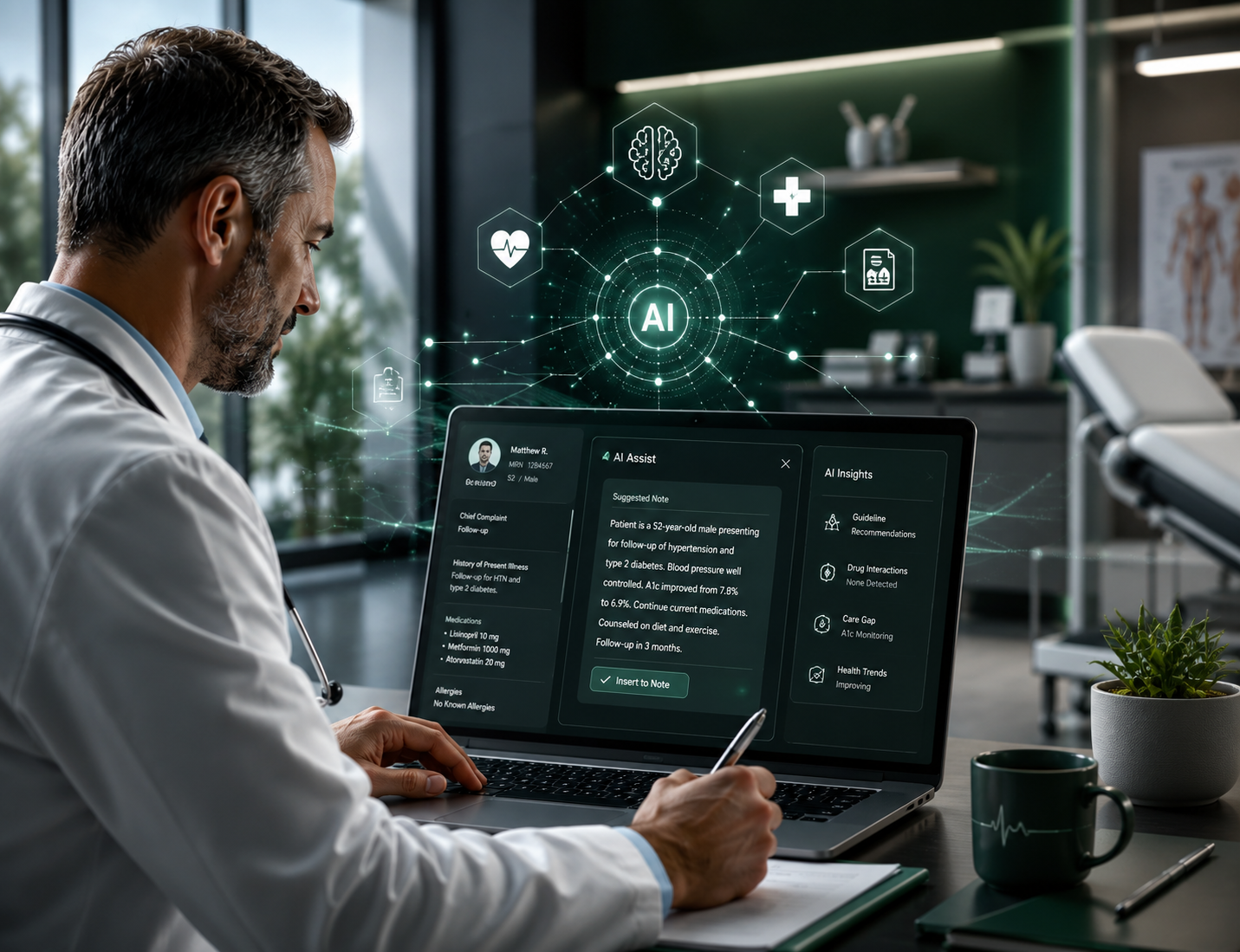
Bernard Chang, dean for medical education at Harvard Medical School, highlighted ambient documentation systems' potential to revolutionize physician workflows by listening to patient visits, recording conversations, and generating organized clinical notes in real time while suggesting diagnoses and treatment courses.
"It's not the most magical use of AI," Chang said. "We've all seen AI do something and said, 'Wow, that's amazing.' This is not one of those things. But this program is being piloted at different ambulatory practices across the country and the early results are very promising. Physicians who feel overburdened and burnt out are starting to say, 'You know what, this tool is going to help me.'
This automation addresses a critical pain point in modern healthcare delivery. The transition from manual documentation to AI-assisted note-taking promises to restore face-to-face patient interactions, potentially strengthening the therapeutic relationship while reducing physician burnout associated with administrative burdens.
Patient Safety Enhancement Through AI Surveillance
David Bates, co-director of the Center for Artificial Intelligence and Bioinformatics Learning Systems at Mass General Brigham, emphasized AI's potential to dramatically improve patient safety. Recent studies by Bates and colleagues revealed that as many as one in four visits to Massachusetts hospitals results in some form of patient harm, with many incidents tracing back to adverse drug events.
"AI should be able to look for medication-related issues and identify them much more accurately than we're able to do right now," said Bates, who also serves as a professor of medicine at the Medical School and of health policy and management at the Harvard T.H. Chan School of Public Health.
The systematic surveillance capabilities of AI systems could fundamentally alter patient safety paradigms by providing continuous monitoring for drug interactions, dosing errors, and clinical deterioration patterns that human oversight might miss.
Addressing Systemic Healthcare Inequities
The current healthcare system faces significant accessibility challenges, with Kohane noting that "unless you're well connected and are willing to pay literally thousands of extra dollars for concierge care, you're going to have trouble finding a timely primary care visit." AI integration offers potential solutions to workforce shortages and access disparities.
"It is no longer a conversation about, 'Will AI replace doctors,' so much as, 'Will AI, with a set of clinicians who may not look like the clinicians that we're used to, firm up the tottering edifice that is organized medicine?'" Kohane observed.
The integration of nurse practitioners and physician assistants with AI-assisted decision support represents one promising approach to expanding access while maintaining quality care standards.
Critical Bias and Data Quality Concerns
Leo Celi, associate professor of medicine at Beth Israel Deaconess Medical Center, highlighted pervasive bias issues stemming from healthcare's historical data collection patterns.
"You need to understand the data before you can build artificial intelligence," Celi said. "That gives us a new perspective of the design flaws of legacy systems for healthcare delivery, legacy systems for medical education."
The bias manifestations are often subtle but consequential. Celi cited research showing non-English speaking patients hospitalized with diabetes receive fewer blood sugar checks compared to English speakers, creating hidden disparities that AI systems might perpetuate without careful attention to data artifacts.
"Most clinicians are not aware that every medical device that we have is, to a certain degree, biased," Celi said. "They don't work well across all groups because we prototype them and we optimize them on, typically, college-age, white, male students."
Accelerating Biomedical Research and Drug Discovery
Marinka Zitnik, associate professor of biomedical informatics, described AI's revolutionary impact on scientific research through systems like Procyon, which bridges knowledge gaps in protein structures and biological functions. "These models provide in-silico predictions that are accurate, that scientists can then build upon and leverage in their scientific work. That, to me, just hints at this incredible moment that we are in."
The research acceleration potential extends beyond individual discoveries to fundamental changes in scientific methodology. Approximately 20 percent of human proteins have poorly defined functions, while 95 percent of research focuses on just 5,000 well-studied proteins, representing a significant knowledge gap that AI systems can help address systematically.
Educational Transformation and Workforce Preparation
Harvard Medical School has introduced comprehensive AI integration initiatives including courses on AI in healthcare, a Ph.D. track in AI medicine, tutor bot development for supplemental learning, and virtual patient systems for skills training before real patient encounters.
However, concerns persist about the educational implications of AI dependence. "The technology is not good enough to have that safety level where you don't need a knowledgeable human," noted Adam Rodman, assistant professor at Harvard Medical School.
"Our current system is incredibly suboptimal but it does train your brain. When people in medical school interact with things that can automate those processes — even if they're, on average, better than humans — how are they going to learn?"
Risk Mitigation and Implementation Challenges
Despite AI's promise, significant concerns remain regarding "hallucination" — the tendency for AI systems to generate false information presented as factual. "AI has a tendency to hallucinate, and that is a worry, because we don't want things in people's records that are not really there," Bates emphasized.
The implementation challenge extends beyond technical considerations to organizational transformation requirements.
"My worry, as both a clinician and a researcher, is that if we don't think big, if we don't try to rethink how we've organized medicine, things might not change that much," Rodman cautioned.
Future Directions and Strategic Imperatives
The Harvard assessment reveals that successful AI integration requires fundamental reconsideration of healthcare delivery models rather than superficial technological adoption. The rapid evolution of AI technology makes long-term preparation challenging, with Rodman noting, "The Harvard view, which is my view as well, is that we can give people the basics, but we just have to encourage agility and prepare people for a future that changes rapidly."
Healthcare organizations must balance ambitious transformation goals with practical implementation challenges, ensuring that AI adoption serves patient welfare rather than merely technological advancement. The successful integration of AI into medical practice will ultimately depend on thoughtful change management, bias mitigation, and sustained commitment to evidence-based implementation strategies.