The Global Healthcare Crisis and AI's Emerging Role
The convergence of global healthcare challenges presents an unprecedented opportunity for technological intervention. Current data reveals that 4.5 billion individuals worldwide lack access to essential healthcare services, while projections indicate an 11 million health worker shortage by 2030. These statistics underscore the urgency of implementing scalable solutions that can extend clinical capacity without proportionally increasing human resource demands.
Artificial intelligence has emerged as a potential catalyst for addressing these systemic challenges. However, adoption patterns reveal a concerning gap: healthcare demonstrates below-average AI integration compared to other industries, according to the World Economic Forum's white paper, The Future of AI-Enabled Health: Leading the Way. This disparity persists despite clear evidence that AI-enabled digital health solutions can enhance efficiency, reduce operational costs, and improve health outcomes across diverse clinical settings.
The fundamental question facing medical leadership is not whether AI can contribute to healthcare transformation, but rather how to accelerate its responsible integration while maintaining clinical standards and patient safety protocols.
Neuroimaging: Enhanced Diagnostic Accuracy in Acute Care
Recent developments in AI-powered neuroimaging analysis demonstrate substantial improvements over traditional interpretation methods. A collaborative study between Imperial College London and Edinburgh University produced software capable of examining stroke patient brain scans with twice the accuracy of clinical professionals. The system underwent training on a dataset comprising 800 brain scans before validation testing on 2,000 patients.
The clinical implications extend beyond simple accuracy improvements. Dr. Paul Bentley, consultant neurologist, emphasized the temporal significance of these findings:
"For the majority of strokes caused by a blood clot, if a patient is within 4.5 hours of the stroke happening, he or she is eligible for both medical and surgical treatments. Up to 6 hours, the patient is also eligible for surgical treatment, but after this time point, deciding whether these treatments might be beneficial becomes tricky, as more cases become irreversible."
The AI system's capacity to determine both stroke occurrence timing and reversibility potential addresses a critical decision-making challenge in acute neurological care, where treatment windows directly correlate with patient outcomes.
Musculoskeletal Imaging: Addressing Diagnostic Gaps
Urgent care settings face a persistent challenge: bone fractures remain undetected in approximately 10% of cases during initial evaluation. This diagnostic gap compounds existing pressures on radiology services, where technician shortages and workflow demands compromise comprehensive case review.
The United Kingdom's National Institute for Health and Care Excellence has evaluated AI-based fracture detection systems and concluded they meet safety and reliability standards while potentially reducing follow-up appointment requirements. These systems perform initial radiographic scans before clinician review, creating a dual-verification process that addresses both false negatives and resource allocation concerns.
However, implementation considerations extend beyond technical validation. Dr. Caroline Green of the Institute for Ethics in AI at the University of Oxford highlighted the necessity of comprehensive training protocols:
"It is important that people using these tools are properly trained in doing so, meaning they understand and know how to mitigate risks from technological limitations... such as the possibility for wrong information being given."
This perspective underscores the critical distinction between technological capability and clinical integration readiness.
Emergency Medical Services: Optimizing Resource Allocation
Ambulance services represent a critical juncture in healthcare delivery where resource allocation decisions directly impact patient outcomes. In the United Kingdom, approximately 350,000 individuals receive ambulance transport to hospitals monthly, with paramedics making real-time determinations about transfer necessity while considering bed availability constraints.
A Yorkshire-based study demonstrated that AI modeling could correctly predict hospital transfer necessity in 80% of cases. The algorithm incorporated multiple clinical variables including patient mobility metrics, pulse characteristics, blood oxygen saturation levels, and chest pain indicators. Notably, the system demonstrated consistent performance without introducing algorithmic bias—a significant consideration given healthcare's documented disparities.
The National Institute for Health and Care Excellence acknowledged the system's potential while emphasizing the need for expanded training protocols before broader deployment. This cautious approach reflects appropriate regulatory oversight in high-stakes clinical environments.
Predictive Analytics: Disease Detection Before Symptom Onset
Machine learning applications in predictive medicine have achieved remarkable sophistication. AstraZeneca's recent development can detect signatures of over 1,000 diseases before clinical symptom manifestation. The system analyzed medical data from 500,000 participants in a United Kingdom health data repository, identifying patterns that predict disease diagnosis years in advance.
Slavé Petrovski, the research lead, explained the temporal advantage:
"For many of these diseases, by the time they manifest clinically and the individual goes to the doctor because of an ailment or visible observation, that is far down the line from when the disease process began. We can pick up signatures in an individual that are highly predictive of developing Alzheimer's, chronic obstructive pulmonary disease, kidney disease and many others."
Complementary research has demonstrated AI's capacity to identify epilepsy-associated brain lesions missed by radiologists in 64% of cases. Trained on MRI scans from over 1,100 patients globally, the system identifies both minute lesions and those obscured by anatomical complexity. Lead researcher Dr. Konrad Wagstyl characterized the challenge:
"It's like finding one character on five pages of solid black text. AI can find about two-thirds that doctors miss—but a third are still really difficult to find."
These findings suggest that optimal outcomes require combining AI detection capabilities with clinician expertise rather than replacing human judgment with algorithmic decision-making.
Clinical Decision Support: Enhancing Information Retrieval
Large language models have garnered significant attention for clinical applications, though standard systems demonstrate limitations in providing evidence-based medical guidance. A United States study evaluated ChatGPT, Claude, and Gemini's capacity to answer clinical questions, finding insufficient relevance and evidence quality for professional use.
However, retrieval-augmented generation systems show greater promise. ChatRWD, which combines large language models with retrieval systems to enhance output quality, produced clinically useful answers to 58% of questions posed—substantially outperforming standard models that achieved 2-10% utility rates.
Digital triage platforms demonstrate parallel potential for workflow optimization. The World Economic Forum's 2024 Digital Healthcare Transformation Initiative documented that the Huma platform reduced readmission rates by 30%, decreased patient review time by 40%, and alleviated provider workload burden. These metrics suggest that properly designed digital interfaces can simultaneously improve clinical outcomes and operational efficiency.
Administrative Burden Reduction: Liberating Clinical Time
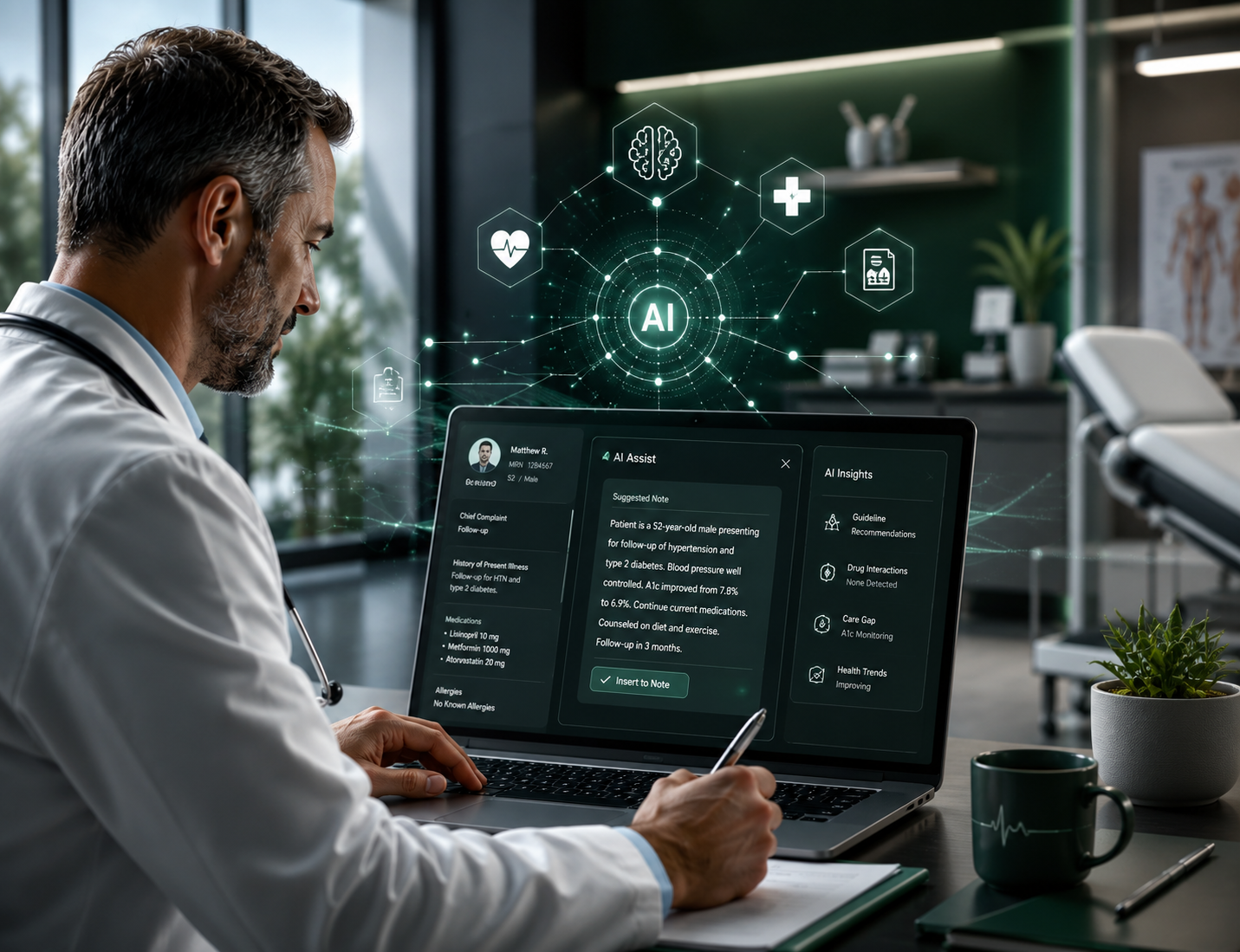
Administrative tasks constitute a substantial proportion of physician time allocation, reducing patient care capacity. AI co-pilot systems aim to address this inefficiency through automated documentation processes.
Microsoft's Dragon Copilot can listen to clinical consultations and generate comprehensive notes, while Google has developed a healthcare-specific AI model suite targeting administrative burden reduction. In Germany, the Elea platform has reduced testing and diagnosis timelines from weeks to hours. Co-founder Dr. Sebastian Casu articulated the fundamental motivation:
"No one joins the healthcare sector to spend hours on admin."
Public acceptance remains variable. United Kingdom research indicates that only 29% of individuals trust AI to provide basic health advice, though over two-thirds accept technology use for liberating professional time. Accuracy concerns persist: OpenAI's Whisper system, utilized by numerous hospitals for patient meeting summarization, has demonstrated transcription hallucinations in documented cases.
These challenges underscore the necessity of rigorous regulatory frameworks. In the United Kingdom, the Medicines and Healthcare products Regulatory Agency maintains strict oversight of AI-powered medical devices. The United States Food and Drug Administration has committed to ensuring safe, effective, and trustworthy AI tools while emphasizing that all involved entities must approach this transformative technology with appropriate rigor.
Strategic Implications for Clinical Leadership
The evidence demonstrates AI's capacity to enhance diagnostic accuracy, optimize resource allocation, and reduce administrative burden across multiple clinical domains. However, successful implementation requires addressing several critical considerations:
First, healthcare organizations must develop comprehensive training protocols that enable clinicians to effectively utilize AI tools while understanding their limitations. Technical capability alone does not ensure clinical utility.
Second, regulatory frameworks must balance innovation promotion with patient safety imperatives. The differential approaches between United Kingdom and United States regulatory bodies suggest ongoing evolution in governance models.
Third, organizations must address public trust concerns through transparent communication about AI system capabilities, limitations, and human oversight mechanisms. The gap between technical performance and public acceptance represents a significant implementation barrier.
Finally, the global healthcare crisis—characterized by access disparities and workforce shortages—creates both urgency and opportunity for AI integration. The technology's potential to bridge these gaps while maintaining clinical quality standards positions it as a strategic imperative rather than an optional enhancement for forward-thinking healthcare organizations.